LED Floor Transition Strip Guide: Smooth, Glowing Transitions Between Any Flooring Materials
Mixing wood, tile, carpet and concrete in one home is a classic design move — but the joint between two different floorings is where projects start to look unfinished. A floor transition strip bridges the gap, protects the edges and stops tripping. Add built-in LED lighting and the seam stops being a compromise and becomes a feature: a soft glowing line that works as a night light, a wayfinding accent and a subtle interior highlight. This guide explains how to transition floor trim of different materials, how to pick the right profile, and why an aluminum strip with a built-in LED channel is the most durable option.
What Are Floor Transition Strips?
Floor transition strips are profile strips installed where two different types, heights or colors of flooring meet. They cover the raw cut edge of each material, level out small height differences, and give the joint a clean, finished look.
They solve three practical problems at once. First, they prevent trips and falls: a 3–5 mm height gap between tile and wood is exactly the kind of edge people catch their feet on. Second, they protect flooring edges from chipping, curling and everyday wear — especially vulnerable at doorways and open-plan room boundaries. Third, they make the design look intentional. A straight, evenly installed strip tells the eye the transition was planned, not improvised.
Why Transitions Matter (And What Happens Without Them)
In open-plan homes, the living room often runs straight into the kitchen, the hallway into the bedroom, and the balcony into the interior. Designers deliberately switch materials to zone the space — wood for warmth in the lounge, tile for practicality in the kitchen, carpet for comfort in the bedroom.
Without a transition strip, that deliberate switch becomes an unfinished edge. Over months of foot traffic the seam collects dust, the flooring edge frays or chips, and the height step becomes a regular trip hazard for children and elderly family members. With a strip — and especially a lighting-integrated aluminum strip — the seam stays crisp for years and adds a practical glow that a plain PVC threshold never could.
The Three Most Common Flooring Materials
To choose the right transition, it helps to know what is on each side of the seam. These three materials cover the majority of residential and commercial floors.
Transition Strip Types by Floor Pairing
Different pairings need different profiles. Here are the most common transition scenarios and the strip that fits each one.
| Floor Pairing | Typical Location | Job of the Strip |
|---|---|---|
| Carpet → Tile | Bedroom to bathroom, living room to kitchen | Level the pile vs. rigid tile and clamp the carpet edge |
| Carpet → Wood | Hallway to bedroom doorways | Neat threshold that lets both surfaces move independently |
| Carpet → Carpet | Between different colors or styles of carpet | Clean seam between two carpet sections |
| Tile → Wood | House entry, kitchen to dining | Smoothly connect hard surfaces with a height difference |
| Tile → Tile | Wall tile to floor tile | Separate surfaces cleanly with a slim profile |
| Carpet → Concrete | Carpet stairs to basement slab | Anchor the carpet and hide the raw edge |
| Tile → Concrete | Balcony to interior | Transition indoor to outdoor slab with drainage-friendly design |
How to Choose: Measure the Height Difference First
The single most important decision factor is the finished height difference between the two floors. The same gap that looks fine with a flat strip will feel like a step with the wrong profile.
| Height Difference | Best Profile | Why |
|---|---|---|
| 0 – 3 mm (roughly level) | Flat T-molding / flat transition strip | Covers the seam with a flush, walkable cap |
| 3 – 12 mm (small step) | Reducer / ramp strip | Tapers the height difference into a gentle slope to avoid tripping |
| 12 mm+ (real step) | Threshold / stair nosing | A proper step edge, not a strip — safety first |
Practical tip: lay a straight edge across the two floors before ordering. If a 1 mm business card slides under the level in some spots and not others, record the worst-case gap and order for that — the strip covers the whole seam, not just the average.
Also match the profile to the traffic. High-traffic entries and commercial floors deserve a heavier aluminum profile; light residential seams can use slimmer profiles. Aluminum handles both, which is why it dominates this category.
Why Aluminum Beats Wood, PVC and Brass
Transition strips come in wood, PVC, brass and aluminum. For a strip that has to survive daily stepping while carrying an LED channel, aluminum is the clear winner.
Why Add LED Lighting to a Floor Transition?
A standard transition strip is passive: it just covers the gap. A LED transition strip turns that thin line of light into a practical and decorative element of the room.
LED Floor Transition Strips from Lightstec
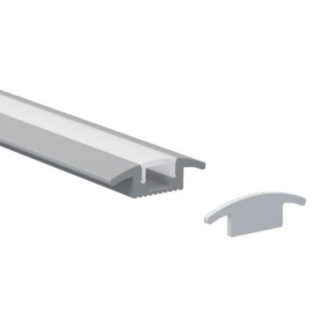
Lightstec supplies anodized aluminum transition profiles with an integrated LED channel. Each profile is extruded to tight tolerances, accepts standard LED strip lights, and is supplied in 1 m or 2 m lengths with matching end caps. The profiles are built for both residential DIY and commercial projects.
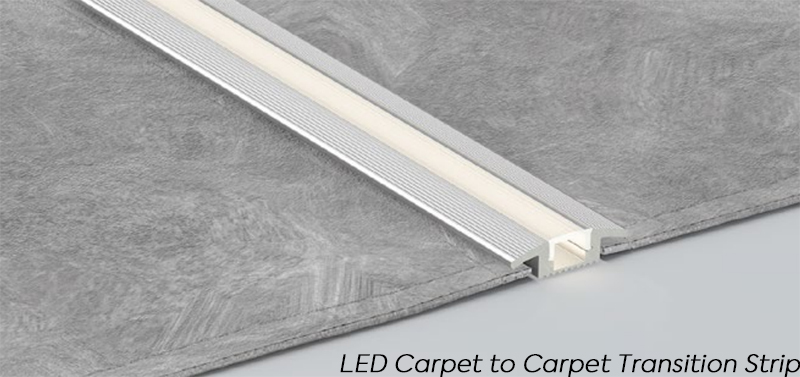
LED Carpet to Carpet Transition Strip
10.3 mm inner width for strip lights · W38.1 mm × H10.8 mm · 1 m / 2 m lengths
Ideal for balancing two carpet sections in bedrooms and offices.
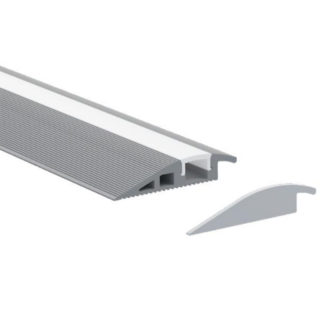
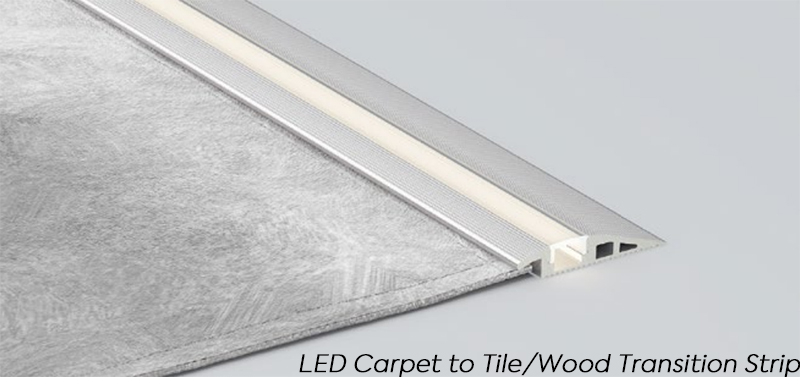
LED Carpet to Tile/Wood Transition Strip
10.2 mm inner width · W57.1 mm × H10.8 mm · 1 m / 2 m lengths
The workhorse for bedroom-to-bathroom and doorway transitions.
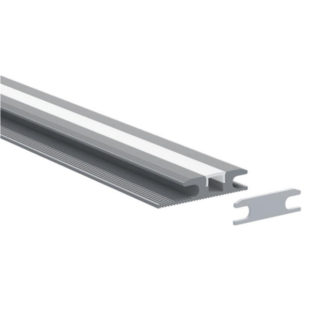
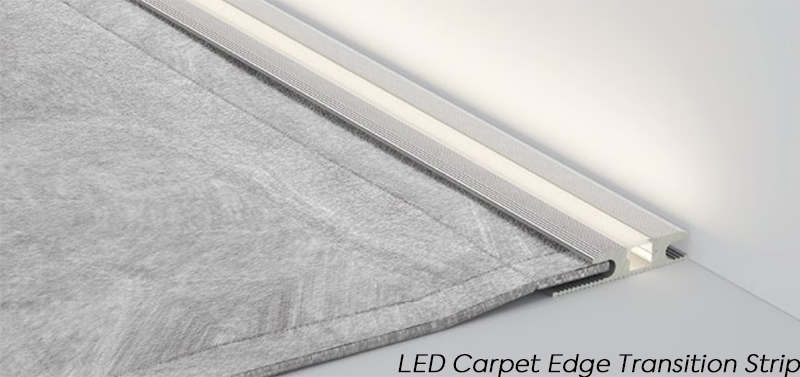
LED Carpet Edge Transition Strip
10.2 mm inner width · W63.5 mm × H12.7 mm · 1 m / 2 m lengths
For finishing carpet edges against walls and open floors.
Installation Tips: How to Install a LED Floor Transition Strip
- Measure and level. Find the finished height of both floors and order the matching profile. A clean, dust-free surface under the strip gives the strongest hold.
- Dry-fit the strip. Lay the profile along the seam and trim it to length with a fine-tooth saw. Use the included end caps on open ends.
- Install the LED strip inside the channel. Peel, stick and press the LED strip firmly into the inner groove. Keep the strip straight and cut it at the marked cut lines.
- Wire and power. Connect the LED strip to a compatible 12 V / 24 V driver. For hardwired installations, run low-voltage cable through the subfloor and hide the driver in a cabinet or junction box.
- Fix the profile and finish. Secure the profile with screws, adhesive or clips per the product instructions, then snap on the face cover. Power up and check for even light along the full seam.
If you are combining several strips in one room, order all pieces in one go and test them together before final fixing — LED brightness and color can vary slightly between batches, and a single continuous line looks best when every meter comes from the same reel.
FAQ
Yes. The profile is extruded aluminum, the same material used in high-traffic floor thresholds. It is rated to take daily foot traffic, and the LED strip sits protected inside the channel.
Any standard 8–10 mm LED strip fits the 10.2–10.3 mm inner width. For floor lighting, a high-density strip (120–180 LEDs per meter) in 2700K–3000K warm white gives the smoothest glowing line; cool white suits modern or commercial spaces.
The aluminum profile protects the LED from dust and light impact. For wet zones such as bathrooms and balconies, use an IP65 silicone-coated LED strip inside the channel and seal the end caps — a combination commonly used in LED floor transition strip installations.
Connect the strip to a matching 12 V or 24 V LED driver with a dimmer if desired. A small 1–2 m run can use an plug-in driver hidden in a cabinet; longer runs should be wired from a central power supply.
Yes. The aluminum profile cuts cleanly with a fine-tooth hacksaw or miter saw, and the LED strip is cut at its marked points. Order 1 m or 2 m lengths and cut on site.
Absolutely. Aluminum transition profiles with LED lighting are widely used in hotels, offices, corridors and care facilities, where a continuous light line doubles as wayfinding and safety marking.
Conclusion
Transitioning between different flooring materials does not have to mean an awkward metal lip or a curled carpet edge. Measure the height difference, pick an aluminum profile that matches the pairing, and — if you want the seam to earn its place in the room — choose a LED floor transition strip that glows softly under foot. The light marks the boundary at night, protects the edge in daily use, and turns the junction between wood, tile and carpet into a deliberate design feature.
Need help choosing the right profile for your project? Contact the Lightstec team with your floor types and height difference — we will recommend the correct strip and compatible LED lighting for your space.

To save you time, we have prepared a PDF catalog with all our latest LED light products, aluminum profiles and transition strips. Leave your email and get it immediately.

Jerry is the founder of Lightstec, a China-based LED strip light and aluminum profile manufacturer. He has been helping architects, designers and lighting buyers choose and customize LED lighting solutions for over 10 years.
Learn More Professional Led Classes Which Less People Tell You Before You Make Mistake.