What Is a Flexible LED Wall Washer?
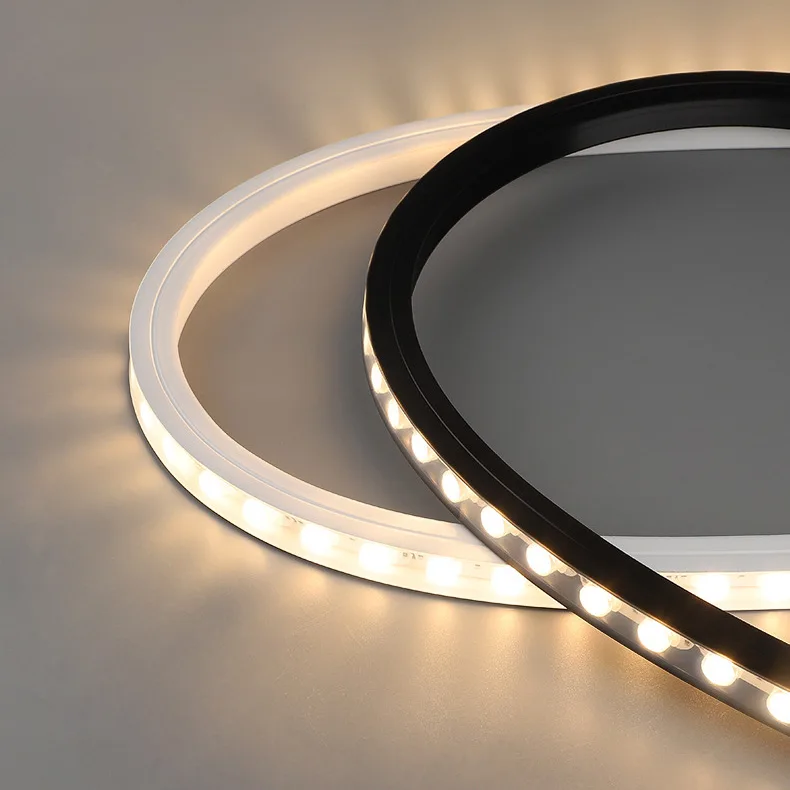
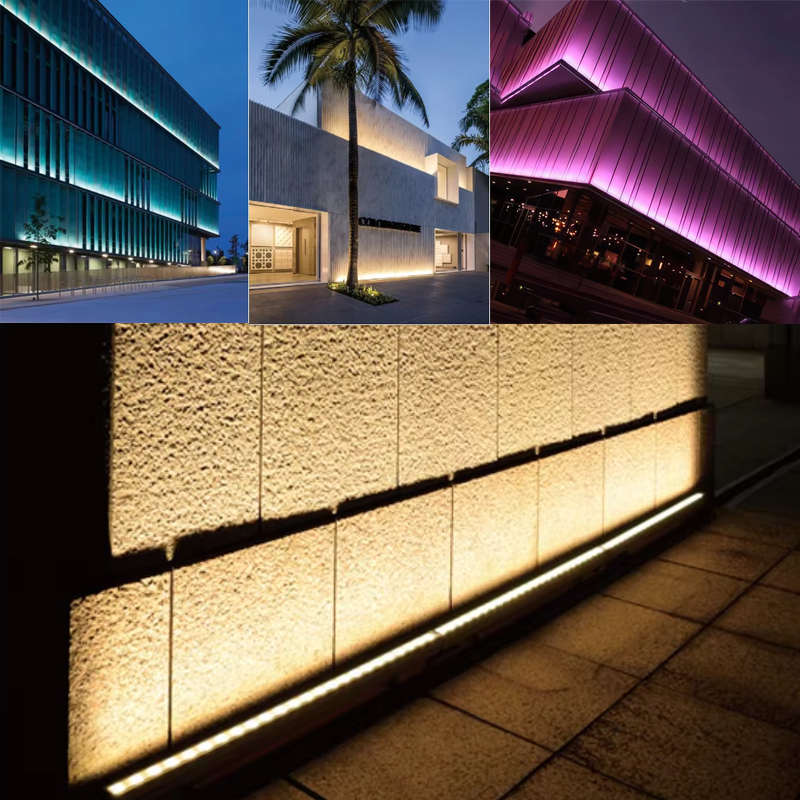
A flexible LED wall washer is a bendable linear lighting fixture engineered to project controlled light onto architectural surfaces—facades, columns, curved walls, and domes—while following complex geometry that rigid wall washers cannot. Unlike a standard LED strip or néon flexível, which emits light in a diffuse 120° cone for direct viewing, a flexible wall washer integrates internal optical lenses that collimate the beam into a directional wash—typically 10°×60°, 30°, 45°, or 60°—to evenly illuminate a surface from a distance.
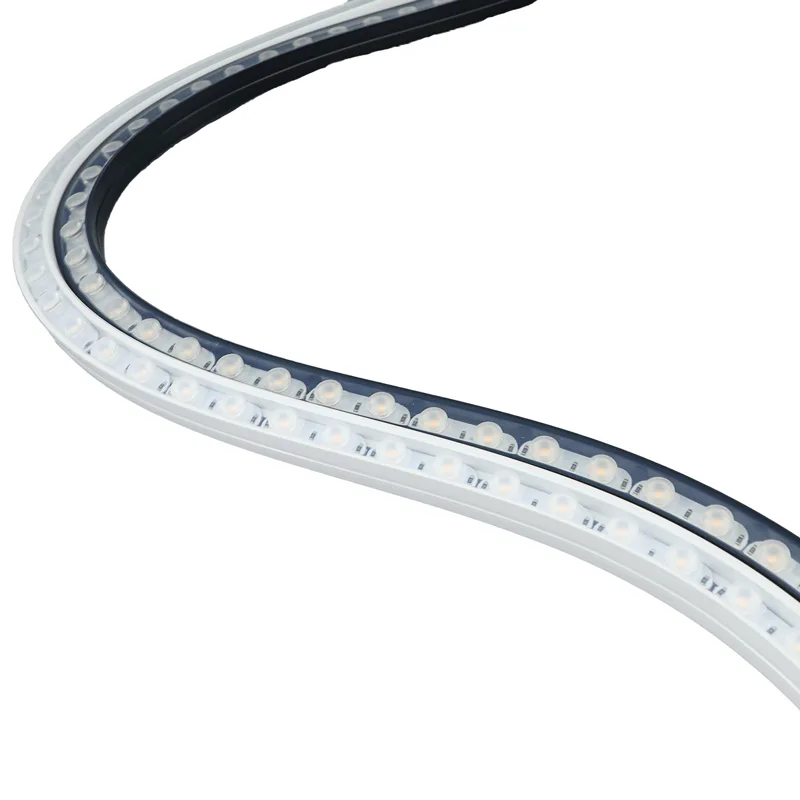
Modern flexible wall washers are built on segmented PCBs housed in extruded silicone or PU sleeves, making them waterproof (IP67/IP68) and capable of top-bending, side-bending, or full 3D bending. They are the go-to solution for lighting designers who need wall-washing performance on curved or organic architecture without fabricating custom rigid fixtures.
On This Page
Three Bending Types: 3D, Top-Bend, and Side-Bend
Not all flexible wall washers bend the same way. Selecting the correct bending direction is the first critical specification—pick the wrong one and the fixture will not sit flush on the surface.
| Tipo | Bending Direction | Melhor para |
|---|---|---|
| Side-Bending | Horizontal curve (left/right) | Curved facades, circular columns, arches |
| Top-Bending | Vertical curve (up/down) | Sloped surfaces, stepped reveals, cove lighting |
| 3D Bendable | Twists on multiple axes | Domes, spiral stairs, parametric facades |
Side-bending (horizontal bending) is the most common. The flexible strip curves left or right in the horizontal plane, ideal for wrapping around circular columns or following a curved building footprint.
Top-bending (vertical bending) curves the strip up or down. This is used when the installation surface slopes—for example, washing light up a curved stairwell or following a sloped ceiling reveal.
3D bendable is the most advanced. Independent PCB segments are connected with flexible bridges inside the silicone housing, allowing the fixture to twist and curve along compound geometry—essential for domes, spiral ramps, and parametric facades.
Beam Angles and Optics That Make It a True Wall Washer
The defining difference between a flexible wall washer and a neon flex strip is the optical system. Neon flex produces a diffuse, omnidirectional glow for direct-view contour lighting. A wall washer uses internal lenses to collimate light and project it across a surface.
| Ângulo de feixe | Efeito | Recommended Use |
|---|---|---|
| 10°–30° | Narrow, throws light far | Tall facades, grazing brick/stone |
| 45° | Balanced spread and reach | General facade, 3–8m walls |
| 60° | Wide, covers broad area | Low walls, ceilings, bulkheads |
| Asymmetrical 10°×60° | Upward throw, minimal back-glare | Professional facade washing standard |
For most architectural facade projects, an asymmetrical lens (10°×60°) is the professional choice. The narrow vertical angle pushes light high up the wall, while the wide horizontal angle spreads it evenly—and the asymmetrical design minimizes glare directed back at the viewer or into nearby windows.
DMX512 Pixel Control for Dynamic Facades
Beyond static white or color lighting, many facade projects require dynamic, programmable effects. Flexible LED wall washers can integrate DMX512 pixel control, dividing the continuous strip into individually addressable segments.
Using addressable ICs (such as WS2811, WS2812B, or SK6812) with DMX-to-SPI decoders, each pixel—typically containing 1, 3, or 6 LEDs—can be controlled independently. This enables chasing effects, color fades, pixel-mapped animations, and even video-like content across the building facade.
Key planning considerations:
- Pixel density = number of controllable segments per meter. Higher density = smoother animations.
- DMX channels depend on color architecture: RGB pixels need 3 channels each, RGBW needs 4.
- Data wiring: daisy-chain DMX from controller to first fixture, with signal amplifiers every 32 fixtures.
- Power injection: inject power every 5–10 meters to avoid voltage drop on long runs.
IP67 vs IP68: Outdoor Waterproofing Explained
Flexible wall washers are deployed on exterior facades where they face rain, UV exposure, temperature swings, and wind. The IP rating determines long-term reliability.
| Avaliação | Proteção | Where to Use |
|---|---|---|
| IP65 | Dust-tight, water jets | Covered eaves, sheltered areas |
| IP67 | Dust-tight, temporary immersion | Exposed facades, rain-exposed |
| IP68 | Dust-tight, continuous submersion | Poolside, fountains, submerged |
For standard building facade applications, IP67 silicone encapsulation is the industry standard. The silicone sleeve is UV-resistant, flexible across temperature extremes (−40°C to +60°C), and maintains its optical and waterproof properties for 50,000+ hours. PU encapsulation is a lower-cost alternative but degrades faster under prolonged UV exposure.
Flexible Wall Washer vs Neon Flex vs LED Strip
Lighting designers often confuse these three products. Here is how to choose:
| Recurso | Faixa de LED | Neon Flex | Flex Wall Washer |
|---|---|---|---|
| Light output | 120° diffuse, dots visible | 120°–180° diffuse, dotless | Directional 10°–60° beam |
| Propósito | Indirect/cove lighting | Direct-view signage, contour | Washing light onto surfaces |
| Bending | Side-bend only | Side/top/3D | Side/top/3D with optics |
| Optics | Nenhum | Diffuser only | Collimating lenses |
| Ar livre | IP20–IP68 | IP65–IP68 | IP67–IP68 |
| Melhor para | Shelves, coves, cabinets | Logos, signs, decorative lines | Facades, columns, curved walls |
Key Specifications to Evaluate
When sourcing flexible LED wall washers for a project, compare these parameters:
- Tensão: Always DC24V for facade lighting (safer, longer runs, less voltage drop). DC12V limits runs to ~5m.
- Wattage per meter: 10–20W/m for most facades; 20–30W/m for tall or high-reflectivity surfaces.
- Temperatura de cor: 2700K–3000K for warm hospitality; 4000K for commercial; RGB/RGBW for dynamic scenes.
- IRC: Minimum CRI 80 for architectural; CRI 90+ for historic buildings or museums.
- Cutting interval: Must match the lens and PCB design. Cutting at the wrong point destroys the optic and waterproof seal.
- Min bending radius: Typically 30–100mm depending on model. Specify on installation drawings.
- Operating temperature: −40°C to +60°C for outdoor-rated products.
Installation Best Practices
1. Plan the optics before mounting. Run a DIALux or AGi32 simulation to determine fixture spacing, mounting distance from the wall, and beam angle. A wall washer mounted too close creates scalloping; too far creates uneven coverage.
2. Use proper mounting accessories. Flexible wall washers typically mount with stainless steel clips, aluminum profiles, or adhesive backing. For outdoor use, prefer mechanical clips over adhesive—UV and temperature cycling will degrade adhesive within 2–3 years.
3. Seal every connection. Use IP68-rated connectors at all cut points, power injection points, and controller connections. Even a single unsealed joint will allow water migration inside the silicone sleeve.
4. Inject power strategically. On runs over 5–8 meters, inject power from both ends or at intermediate points. Voltage drop causes visible brightness gradient.
5. Protect against surge. Install SPD (surge protection devices) at the driver end for tall buildings. Lightning-induced surges are the #1 cause of facade lighting failure.
Perguntas frequentes
Can I use a regular LED strip as a wall washer?
You can, but the result will be uneven. A bare LED strip emits a 120° diffuse cone with visible LED dots. Without collimating optics, you will see hotspots and scalloped light. A flexible wall washer with integrated lenses produces smooth, even illumination.
What is the maximum run length?
On DC24V, a single power feed supports 5–10 meters depending on wattage. For longer runs, use dual-end power injection. DMX data can run up to 32 fixtures without a signal amplifier.
Can flexible wall washers be dimmed?
Yes. Most models support 0–10V, DALI, TRIAC, or DMX dimming. For dynamic color-changing projects, DMX512 is the industry standard. Always pair with a compatible dimmable LED driver.
What is the lifespan outdoors?
Quality silicone-encapsulated models are rated for 50,000 hours at L70. With proper installation and sealed connections, expect 8–10 years of outdoor service. Cheap PU-coated versions may fail within 2–3 years due to UV degradation.
Can I cut a wall washer to length on site?
Only at marked cutting intervals with re-connectable waterproof connectors. Cutting at the wrong point breaks the optical lens alignment and waterproof seal. For critical projects, specify factory-cut lengths.
Need Custom Flexible Wall Washers for Your Project?
Lightstec engineers flexible linear lighting solutions—custom bending directions, beam angles, lengths, and DMX pixel mapping—for commercial and architectural facade projects worldwide.
Looking for related products? Explore our Luzes lineares LED, Perfis de alumínio LED, e LED néon flexível, or check our FAQ page for more technical answers.
Aprenda mais aulas ministradas por profissionais que menos pessoas lhe dirão antes de você cometer um erro.