
Relacionado: lee nuestro best led strip light supplier in uk.
Blue light hazard is one of the first questions lighting contractors ask on commercial projects. This guide explains the IEC 62471 standard in plain English — what blue light hazard is, how LED strips are classified RG0–RG3, and how Lightstec documents photobiological safety for every strip we ship.
When a project specification asks for “IEC 62471 compliance”, it is asking one specific question: is this light source safe for human eyes and skin under normal use? The International Electrotechnical Commission (IEC) answers that question with a worldwide standard for the photobiological safety of lamps and lamp systems — and for LED strip lights, the most discussed part of it is the retinal blue light hazard.
Because LED strips are used for close-range, long-duration lighting in offices, retail, hospitality and residential projects, buyers increasingly need documented proof of compliance, not just a claim. This article walks you through the standard, the risk groups, and the test reports Lightstec holds for its LED strip products.

What Is Blue Light and Why It Matters in LED Projects
Potential Effects of Blue Light on the Human Eye
What Is the IEC 62471 Standard?
IEC 62471 Risk Groups: RG0 to RG3
How Blue Light Hazard Is Tested
Are LED Strip Lights Safe for the Eyes?
Why IEC 62471 Compliance Matters for Your Project
Lightstec’s Blue Light Safety Commitment
Recommended Lightstec LED Strips
What Is Blue Light and Why It Matters in LED Projects
Blue light is the high-energy, short-wavelength portion of visible light, roughly between 400 and 500 nm. The 415–455 nm band carries the highest energy per photon, which is why it is the focus of blue light hazard assessments.

White LEDs produce blue light by design: a blue chip excites a phosphor coating that converts part of the emission to a broad white spectrum. A well-designed strip keeps the remaining blue component well within safe limits. When clients ask about blue light, they usually want to know three things: is the product tested, to which risk group does it belong, and can you prove it?
Potential Effects of Blue Light on the Human Eye
Blue light is not “harmful light” — it is a normal part of daylight. The concern is photochemical exposure: high-energy blue light over long exposure can contribute to retinal stress. In practice, the relevant factors are brightness, exposure duration and viewing distance, not the mere presence of blue light.
Retinal Photochemical Load
High-energy 415–455 nm light is the band weighted in blue light hazard calculations.
Visual Fatigue & Glare
Very bright, undiffused sources seen at close range can cause discomfort and fatigue.
Circadian Rhythm
High blue content late at night can affect melatonin and sleep patterns.
This is precisely why international standards exist: to quantify the risk and classify products so specifiers can choose fixtures that are safe for prolonged, close-range use.
What Is the IEC 62471 Standard?
IEC 62471, “Photobiological Safety of Lamps and Lamp Systems”, is the international benchmark for evaluating light radiation hazards to the eyes and skin. It covers wavelengths from 200 nm to 3000 nm — ultraviolet, visible and infrared — and applies to all non-coherent broadband light sources, including LEDs (lasers are excluded).
Lightstec has held IEC and EN62471 photobiological safety documentation for its LED strip products since 2017–2018, including third-party EN62471 test reports for single-colour and RGB strips.
IEC 62471 Risk Groups: RG0 to RG3
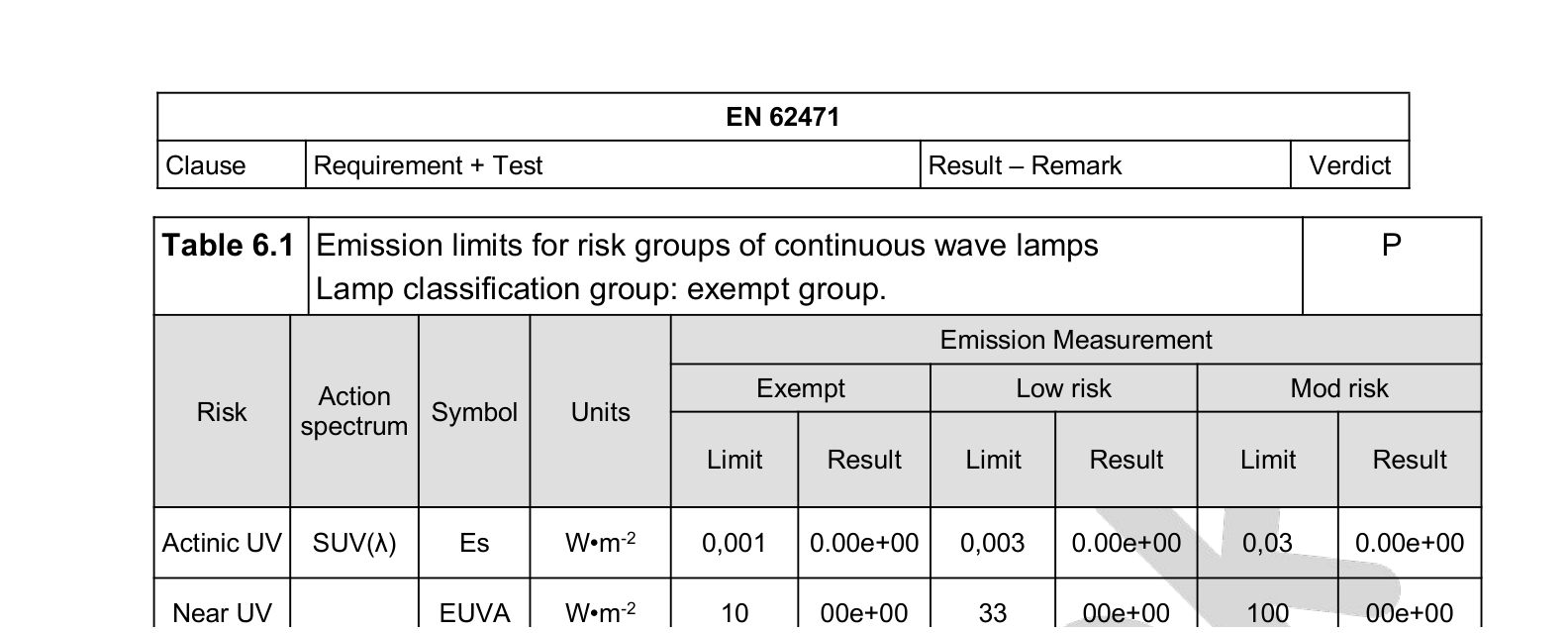
Based on weighted blue light radiance and exposure time, IEC 62471 places every light source into one of four risk groups. The higher the group, the shorter the safe viewing time before risk appears.
| Risk Group | Name | Safe Viewing Time | Uso típico |
|---|---|---|---|
| RG0 | Exempt | Over 10,000 s (long-term) | General & decorative lighting — the target for LED strips |
| RG1 | Low Risk | 100 – 10,000 s | Normal interior lighting, acceptable for most projects |
| RG2 | Moderate Risk | 0.25 – 100 s | High-brightness industrial / spotlights, requires warning |
| RG3 | High Risk | Under 0.25 s | Not suitable for general consumer lighting |
For indoor decorative and linear lighting, RG0 and RG1 are the widely accepted, project-ready levels. Lightstec LED strip products are designed and documented to meet these levels, with most standard white and RGB strips falling in the RG0/RG1 range.
How Blue Light Hazard Is Tested
Blue light hazard is measured, not guessed. The laboratory procedure follows a defined sequence:
Measure
Radiant energy is measured across 400–500 nm with a calibrated radiometer.
Weight
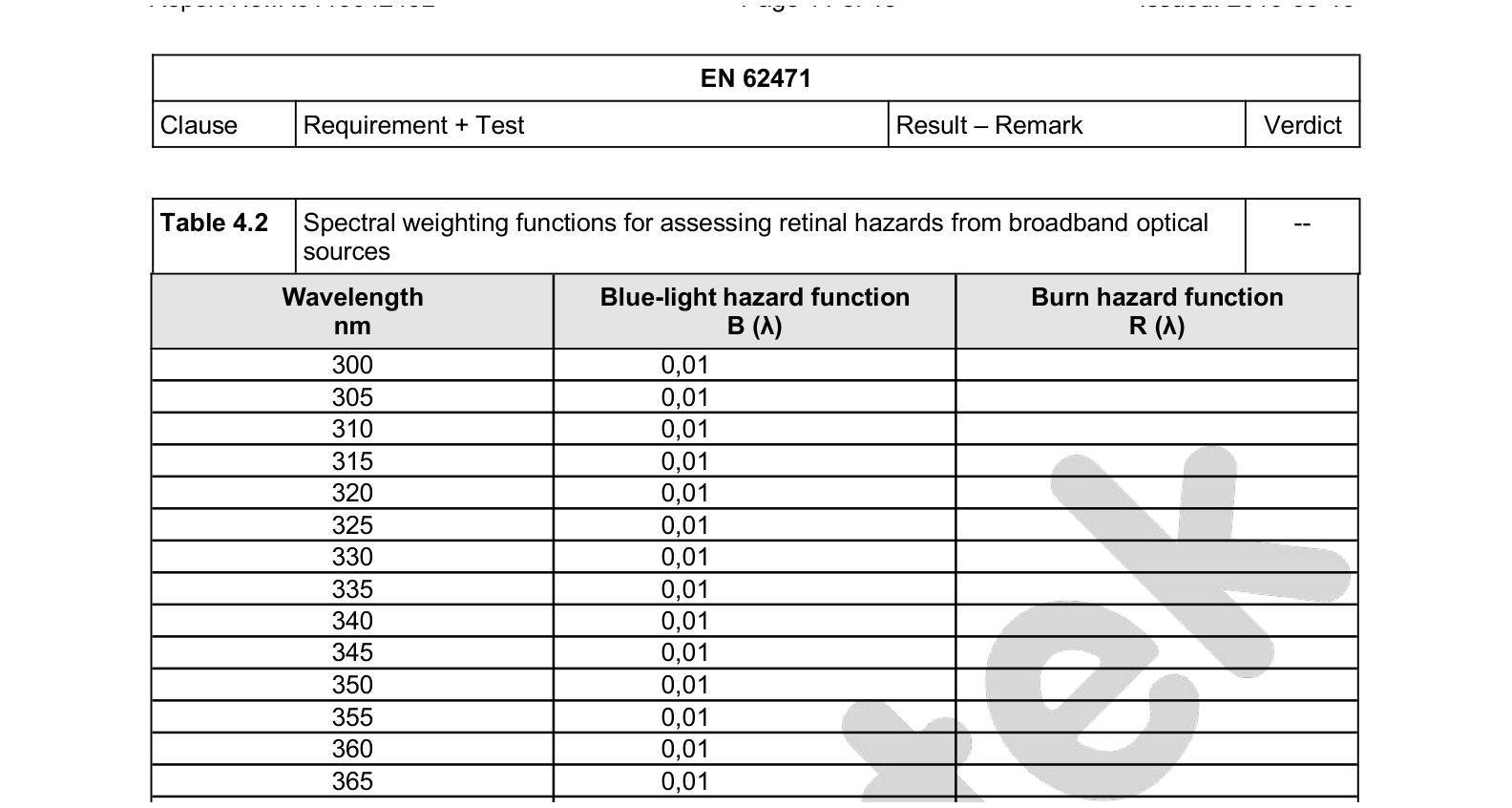
Values are weighted with the blue light hazard function B(λ), which emphasises 415–455 nm.
Evaluate
Blue light weighted radiance is compared with exposure time, viewing angle and distance.
Classify
The result places the product in RG0, RG1, RG2 or RG3.
For general lighting, evaluation is typically done at an illuminance of 500 lx and not less than 200 mm. For continuous light sources like LED strips, the test also looks at luminance distribution and how optical diffusion reduces localized bright spots — which is why a diffused strip can be bright yet still RG0/RG1.
Are LED Strip Lights Safe for the Eyes?
Under normal installation and use, yes. LED strips are almost always installed for indirect, cove, under-cabinet or accent lighting — light that illuminates surfaces rather than shining directly into the eye. Three factors keep them comfortable and safe:
Indirect Mounting
Strips light surfaces and spaces; users rarely stare at the source.
Optical Diffusion
Diffusers and aluminium profiles spread the light and cut glare.
Classified Design
Tested strips sit in RG0/RG1, safe for prolonged exposure.

Only an extremely bright, undiffused strip viewed at very close range could cause discomfort — and even then, high brightness does not automatically mean high blue light risk. Good optical design maintains brightness while keeping the hazard inside safe limits.
Why IEC 62471 Compliance Matters for Your Project
For specifiers and importers, documented IEC 62471 compliance is no longer optional on many projects. It affects:
Project Bidding & Acceptance
Many tenders now require photobiological safety documentation as a pass condition.
Export & Market Access
Compliance supports CE / market entry where photobiological safety applies.
Brand & End-User Trust
Documented safety protects your reputation and the health of end users.
When you specify a compliant strip, you also need the power supply and controller to be part of a reliable system — see our guide on choosing the right LED strip power supply.
Lightstec’s Blue Light Safety Commitment
Photobiological safety has been part of Lightstec’s quality system since our early product lines. Our LED strip products are designed to meet IEC 62471 RG0/RG1 blue light safety, and we hold third-party test reports that document it — including EN62471 photobiological safety reports for single-colour, warm white and RGB LED strips.
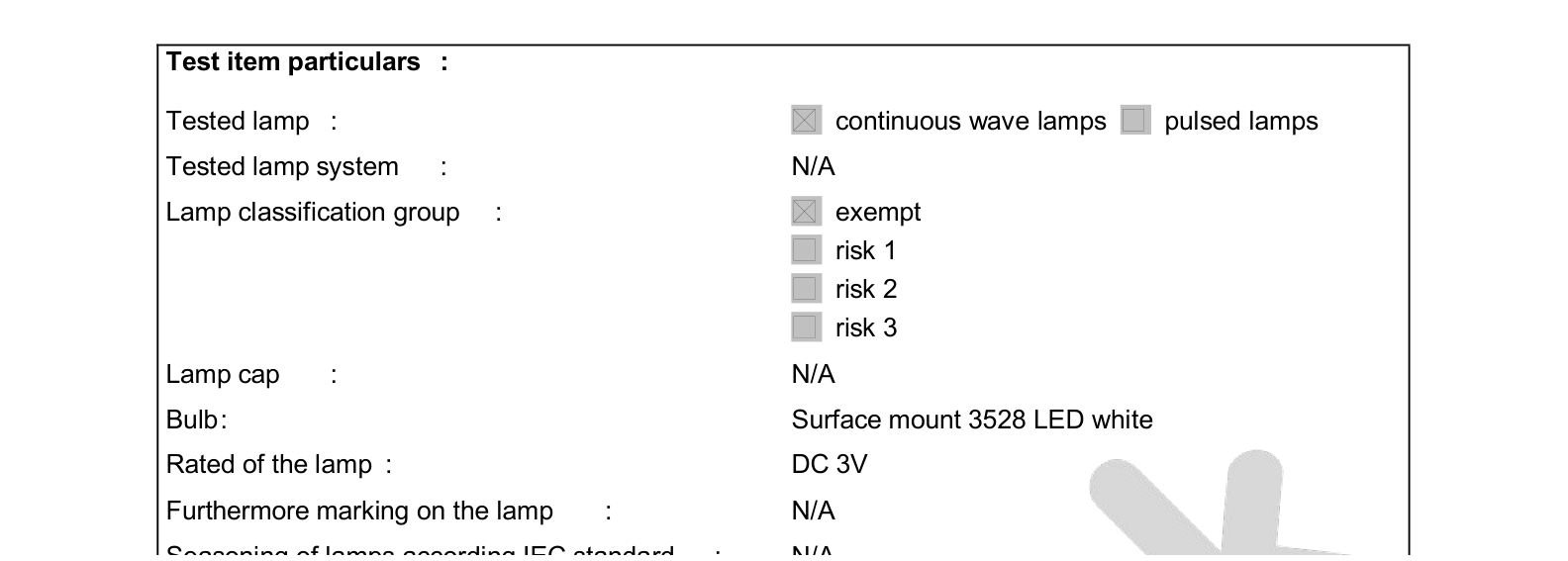
When you request IES files and LM-79/LM-80 data for a project, we can also provide the IEC 62471 / EN62471 photobiological safety report for the relevant strip type. Want to judge quality yourself? Our guide on how to choose a quality LED strip explains what to check.
Download EN62471 Test Report (PDF)
Recommended Lightstec LED Strips
Every strip below is manufactured in our factory and available with IEC 62471 / EN62471 documentation on request. Click any product to view the series and request a quote.


Preguntas frecuentes
What is the IEC 62471 standard?
IEC 62471 is the international standard for the photobiological safety of lamps and lamp systems. It evaluates the potential hazard of light radiation — including blue light, UV and infrared — to human eyes and skin, and classifies light sources into risk groups RG0–RG3.
Are RG0 and RG1 LED strips safe for the eyes?
Yes. RG0 (exempt) and RG1 (low risk) are considered safe for normal and prolonged use and are the levels accepted for indoor general and decorative lighting. Most quality LED strips are designed to meet RG0 or RG1.
Does LED strip lighting damage your eyes?
Under normal installation, no. LED strips are typically mounted indirectly and used with diffusers, so exposure is low and within safe limits. The blue light risk depends on brightness, duration and viewing distance — which is exactly what IEC 62471 classifies.
Does Lightstec provide IEC 62471 test reports?
Yes. Lightstec holds IEC and EN62471 photobiological safety documentation for its LED strip products, including third-party EN62471 test reports for single-colour, warm white and RGB strips. Request the report matching your product type and colour temperature.
How can I get the EN62471 report for a Lightstec strip?
Download the sample EN62471 test report above, or contact our team with your product model and CCT. We will provide the matching IEC 62471 / EN62471 photobiological safety documentation with your quotation.
Do I need blue-light-blocking glasses with LED strips?
No. LED strip lights that comply with IEC 62471 RG0/RG1 do not require special eyewear for normal indoor use. Blue-light-blocking glasses are relevant for screen use scenarios, not for compliant, diffused LED lighting.
Need IEC 62471 Documentation for Your Project?
Request EN62471 test reports, LM-79 / LM-80 data and factory-direct pricing for your next LED strip project. Our engineers will match the right product and compliance documents for your specification.
Obtenga más clases dirigidas por profesionales que menos personas le dirán antes de cometer un error.
Blue light safety is something too few people check. This explanation of IEC 62471 is clear and easy to pass on to our project team. Thank you.
Very informative article on blue light safety. We value Lightstec’s compliance and professional approach. Working with them has been a great experience and we will definitely cooperate again.