Hotel lighting is not about brightness — it is about experience. The right lighting makes guests feel welcome, relaxed, and willing to pay more. The wrong lighting makes a $500 room feel like a budget motel. In this guide, we break down everything designers, contractors, and procurement teams need to know about hotel LED strip lighting — from color temperature and dimming to zone-by-zone specification and product selection.
On this page:
Why LED Strip Lighting Is Transforming Hotel Design

Modern hotels no longer rely on a single overhead fixture. Today’s hospitality lighting is layered, hidden, and controllable — and LED strip lights are the engine behind it all. They hide in ceiling coves, behind headboards, under bathroom vanities, inside wardrobe shelves, and along corridor walls. The guest never sees the light source; they only feel the atmosphere it creates.
Here is why LED strips have become the default choice for hotel projects worldwide:
- Hidden integration — strips sit inside aluminum profiles or millwork grooves, invisible to the guest.
- Energy efficiency — LED strips use 80% less energy than halogen, reducing hotel operating costs year after year.
- Long lifespan — quality strips rated 50,000+ hours mean less maintenance and fewer room service calls.
- Dimmable & smart-ready — compatible with DALI, 0-10V, Triac, and key-card control systems.
- Flexible form factor — bend around curves, cut to length, fit into tight spaces no fixture can reach.
Core Design Principles for Hospitality Lighting
Before specifying a single product, lock down these four fundamentals. They determine whether your hotel lighting feels like a boutique resort or an office building.
1. Color Temperature: 2700K–3000K Is the Standard
Hotel guest rooms should always be lit at 2700K to 3000K warm white. This range is warm enough to feel residential and relaxing, but bright enough to be functional. Anything above 3500K in a bedroom reads as “clinical” and disrupts melatonin production — the opposite of what a hotel room should do.
| Zone | Suositeltu CCT | Miksi |
|---|---|---|
| Guest room ambient | 2700K–3000K | Relaxing, flattering, sleep-friendly |
| Desk / work area | 3500K–4000K | Crisper light for reading/work |
| Bathroom vanity | 3000K | Flattering skin tones, good CRI |
| Corridors | 2700K | Welcoming at night, not jarring |
| Lobby | 3000-3500K | Grand and inviting |
| Restaurant | 2700K | Food looks better, guests stay longer |
2. CRI: Aim for 90+ — Go 95 for Food & Skin
Color rendering index (CRI) measures how accurately a light source reveals true colors. For hotels, CRI ≥ 90 is the baseline. For restaurants, spas, and bathroom vanities where skin tones and food appearance matter, specify CRI 95+ with R9 > 50. Low CRI light makes wood look dull, fabric look flat, and skin look washed out.
3. Dimming: Dim-to-Warm Is the Premium Standard

The best hotel lighting doesn’t just dim brightness — it also shifts color temperature as it dims. Dim-to-warm strips start at 2700K at full brightness and smoothly transition down to 1800K (candlelight warm) at 1% dim. This creates a natural, incandescent-like experience that modern guests expect from upscale properties.
Common guest room scenes:
- Arrival: 100% brightness, 2700K — bright enough to unpack
- Evening: 40–60% brightness, 2200K — cozy for reading or TV
- Sleep: 5–10% brightness, 1800K — night light, supports melatonin
4. Layered Lighting: Ambient + Task + Accent
Every hotel room needs three independent lighting layers on separate circuits:
- Ambient — cove lighting or ceiling downlights for general illumination
- Tehtävä — bedside reading lights, desk lamp, vanity mirror light
- Aksentti — under-bed glow, wardrobe interior, shelf backlighting, TV wall wash
Hotel Lighting by Zone: Where to Use LED Strips
Guest Room: The Headboard, Cove & Under-Bed

The guest room is where lighting earns its reputation. Three strip-light locations deliver the biggest impact:
Behind the headboard. A COB LED strip in an aluminum profile mounted horizontally behind the headboard creates a warm wall wash that makes the room feel larger and more luxurious. Use 2700K, CRI 90+, dimmable to 1%.
Ceiling cove. Perimeter cove lighting washes the ceiling in indirect light, making the room feel taller. This is the #1 signature detail in boutique hotels. Use a high-density COB strip to eliminate visible dots.
Under-bed / toe-kick. A low-brightness strip under the bed frame acts as a nightlight — guests can navigate to the bathroom without turning on harsh overhead lights. This detail alone improves guest reviews.
Corridors & Hallways

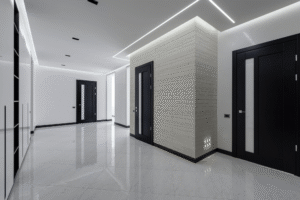
Hotel corridors need to be safe but not stark. LED strips along the ceiling cove or wall base create a welcoming path. Add motion sensors that dim to 20% at night and ramp to 100% when a guest approaches. Keep CCT at 2700K throughout — mixed color temperatures in a corridor read as unfinished.
Lobby & Public Areas

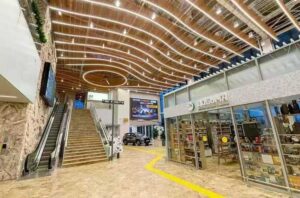
The lobby sets first impressions. LED strips in ceiling coves, behind reception desks, and along feature walls create a sense of grandeur. For lobby ceilings, use 24V COB strips with high lumen output. Consider tunable white (3000K–4000K) for ballrooms and event spaces that need to shift from daytime conferences to evening galas.
Restaurants & Bars
Restaurant lighting should make food look delicious and people look good. That means 2700K, CRI 95+, dimmable. LED strips under bar counters, along shelving, and in decorative neon signatures create atmosphere. For cocktail bars, RGBW strips allow subtle color shifts — but keep white tones dominant.
Kylpyhuoneet
Bathroom strips need to be moisture-resistant (IP44 minimum, IP65 near shower zones). Use 3000K CRI 90+ around the vanity mirror for flattering grooming light. LED strips inside the medicine cabinet mirror (backlit) create a Hollywood-style glow guests love.
Exterior & Facade
For hotel exterior lighting, use IP67/IP68 waterproof LED strips or silicone neon flex. Outline the building roofline, accent columns, and landscape features. Ensure all exterior strips are 24V and protected with appropriate surge protection.
Choosing the Right LED Strip Type for Hotels
Not all LED strips are equal. Here is how to match the strip to the application:
| Nauhan tyyppi | Paras | Key Advantage |
|---|---|---|
| COB LED Strip | Coves, headboards, millwork, any direct-view linear | Completely dotless, smooth continuous light |
| SMD2835 Strip | Under-cabinet, wardrobe, shelf lighting (budget projects) | Cost-effective, efficient, widely available |
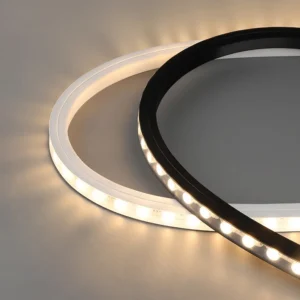
| LED Neon Flex | Curves, decorative signatures, outdoor facade, bar signage | 360° glow, weatherproof, durable |
| RGBW / RGBCCT | Ballrooms, bars, themed spaces, event lighting | Full color + quality white in one strip |
Rule of thumb: If the strip will be visible (even through a diffuser), use COB-nauha for a seamless line. If it’s hidden inside an aluminum profile with a frosted diffuser, SMD2835 works well. For curved or outdoor decorative elements, use neon flex.
LED Aluminum Profiles: The Hidden Framework

The strip is only half the system. The LED alumiiniprofiili it sits in determines heat dissipation, light quality, and installation finish. For hotel projects:
- Recessed drywall profiles — for seamless ceiling coves and corridor walls (drywall-integrated, painted over)
- Surface-mounted profiles — for retrofit projects, under cabinets, wardrobe interiors
- Corner profiles — for 90° angles where wall meets ceiling or floor
- Linear light housings — for pendant fixtures in lobbies and restaurants
Always pair strips with a proper aluminum channel. Bare LED strips overheat, degrade faster, and look unfinished. The profile also enables clean diffuser coverage, eliminating LED dot visibility. Learn more about surface-mounted profiles ja recessed extrusions.
Hotel Control Systems: DALI, 0-10V, or Triac?
The control protocol determines how scenes are programmed, how rooms are managed from the front desk, and how much the system costs. Choose based on project tier:
- DALI (Digital Addressable Lighting Interface) — the professional standard for 4–5 star hotels. Individual addressability per fixture, full scene control, integrates with BMS. Higher cost but maximum flexibility.
- 0–10V — simpler commercial dimming. Good for ballrooms, corridors, and public areas where per-room control isn’t needed.
- Triac / Phase-cut — cost-effective for guest rooms with standard wall dimmers. Works well with dim-to-warm strips but less precise than DALI.
- Key-card / RFID integration — every hotel room needs this. When the guest inserts the key card, lighting powers on; when they leave, it powers off. Ensure your LED drivers are compatible with the hotel’s key-card system before ordering.
Recommended LED Products for Hotel Projects
Factory-direct LED strips and profiles from Lightstec — configured for hotel projects worldwide:
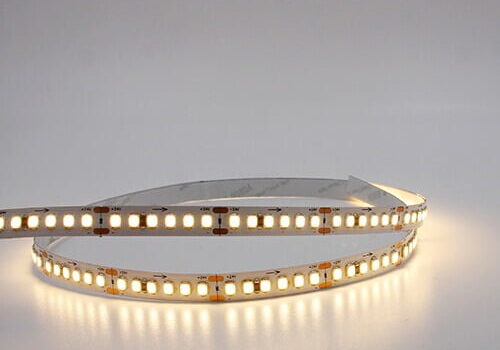
SMD2835 120LED/m 24V
CRI90+, 2700K/3000K, dimmable. Best for wardrobe, shelf, and under-cabinet lighting.
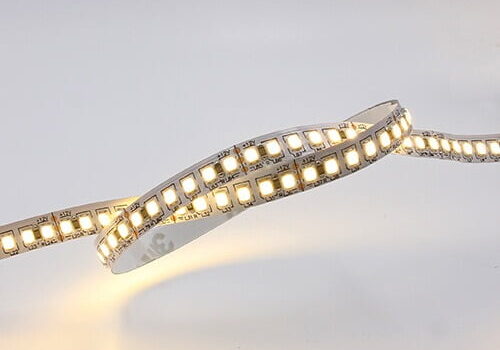
COB LED Strip 320/528 LEDs/m
CRI97+, dotless, 2700K–4000K. Ideal for coves and headboards where smooth light matters.

LED-alumiiniprofiilit
Surface, recessed, corner, drywall series. 6063-T5 aluminum, opal diffuser.
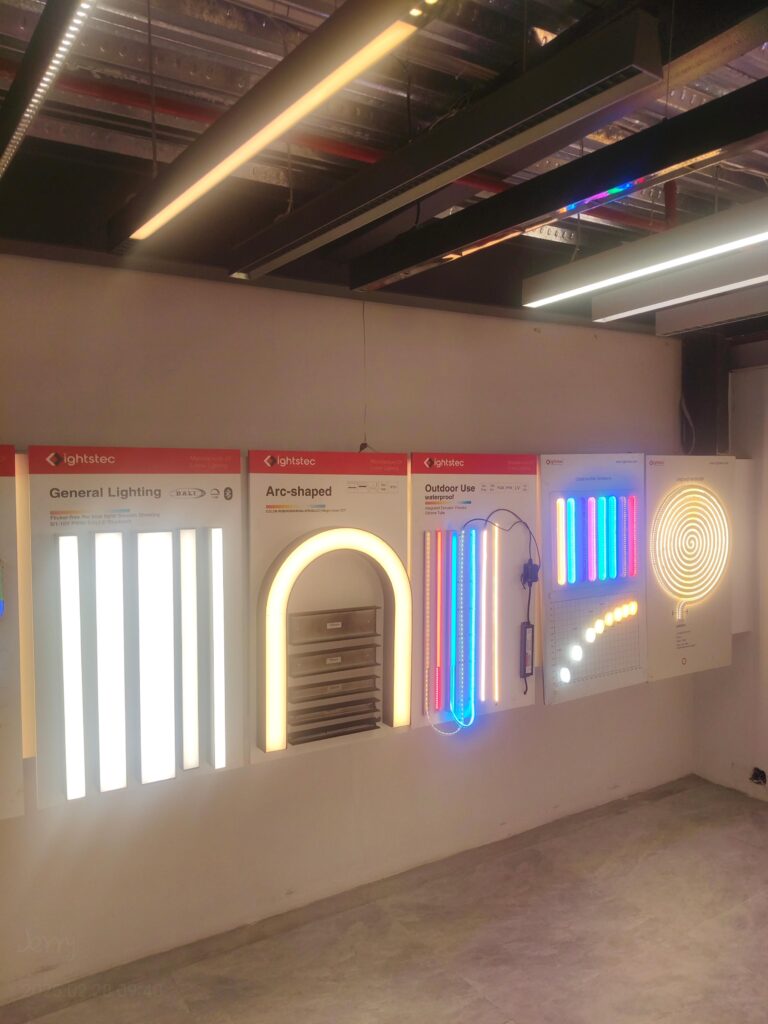
LED Neon Flex
IP67 waterproof, 2700K warm white. For bar signatures, curves, and exterior facade.
Usein kysytyt kysymykset
What color temperature is best for hotel guest rooms?
2700K–3000K warm white is the hospitality industry standard. It creates a relaxing, flattering atmosphere that supports sleep. Avoid anything above 3500K in the bedroom — it suppresses melatonin and feels commercial.
Should I use 12V or 24V LED strips for a hotel project?
Always use 24V for hospitality projects. 24V strips support longer runs (up to 10m per driver before voltage drop becomes visible), use thinner cables, and have better dimming compatibility. 12V is only suitable for short decorative runs under 3m.
What CRI rating do hotels need?
CRI 90 is the minimum baseline for all guest-facing areas. For restaurants, bathroom vanities, and spa treatment rooms where skin tones and food appearance matter, specify CRI 95+ with R9 > 50.
Can LED strips be dimmed smoothly in hotel rooms?
Yes — but you need compatible drivers and dimming protocols. Dim-to-warm strips paired with DALI or TRIAC dimmers deliver smooth, flicker-free dimming down to 1%. Always test the exact driver + strip + dimmer combination on a sample before bulk order.
How do I choose between COB and SMD strips for a hotel cove?
If the cove is visible or uses a clear/half-frosted diffuser, use COB for a completely dotless line. If the strip sits deep inside a cove with an opaque diffuser, high-density SMD2835 (120+ LEDs/m) will also look smooth at a lower cost.
What IP rating do I need for hotel bathroom strips?
IP44 minimum for vanity mirror lighting. IP65 for zones near showers or steam rooms. Always use waterproof end caps and connectors for wet-area installations.
Source Your Hotel LED Lighting from Lightstec
Lightstec has supplied LED strips, neon flex, and aluminum profiles to hotel and hospitality projects across 80+ countries. We work directly with lighting designers, MEP contractors, and hotel procurement teams to deliver customized, project-ready lighting packages — from spec and sampling to volume production and delivery.
Ota yhteyttä with your hotel project drawings and we will recommend the right strip type, CCT, dimming, and profile configuration. Free samples available for quality evaluation.
Ready to Light Up Your Next Hotel Project?
Send us your drawings — get a free lighting spec and sample within 48 hours.

Jerry Hu
Founder of Lightstec®. 13+ years in LED strip light manufacturing. Helping hoteliers, contractors, and lighting designers worldwide spec the right LED lighting — on time, on budget, zero defects.
Lue lisää ammattimaisista ohjatuista kursseista, joista vähemmän ihmiset kertovat sinulle ennen kuin teet virheen.